
In this contribution, Marina Schepetow, Master’s Student in East-West Studies at the University of Regensburg, elaborates on the relevance of cultural and community spaces as the M26 for the sense of belonging of newcomers and refugees in Regensburg. Based on semi-structured interviews and observations in the field, the results of her research project show that M26 is not only a place of networking, exchange of perspectives and spatial appropriation, but also fosters responsibility, mutual trust and acceptance among initiators, social workers and visitors.
Marina Schepetow is part of the panel discussing migration and the image of the city (“Stadtbild”) as part of the Nacht.Schafft.Wissen events at Landshuter Str. 4 on 24 April 2026. Join from 19:00 to 20:30, no registration is required.
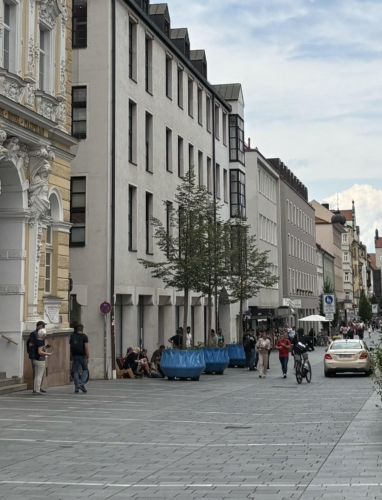
Maxmilianstrasse, Regensburg. Photo by Marina Schepetow.
Generate PDF
Despite Maximilianstrasse having lost some of its popularity over time, having been framed as a “transit” street, it nevertheless remains a gateway to the city. Thus, the community and cultural space M26 reaches a broad public, but especially marginalized groups as refugees and newcomers to the city
Once a colleague, born and raised in Regensburg, told me: “Maximilianstraße is a place where I would rather not hang out, but pass through as fast as I can”. According to the local news and media coverage, as well as urban renewal plans by the city of Regensburg, Maximilianstrasse is a highly contested street with rather negative associations highlighting crime and vacancy. At the same time, it appears to be a lively street with a huge ethnic and commercial diversity that is quite rare in the historically old part of Regensburg. Further, what makes it even more special, is the location of the Office for Migration and Integration, and the interim use project called M26, a space for culture, art and community. Both institutions share one building and the same house number. Despite Maximilianstrasse having lost some of its popularity over time, having been framed as a “transit” street, it nevertheless remains a gateway to the city. Thus, the community and cultural space M26 reaches a broad public, but especially marginalized groups as refugees and newcomers to the city, who mostly live in refugee accommodation on the outskirts of the city.
In the summer semester 2025 together with Prof. Dr. Anna Steigemann at University of Regensburg got to know Maximilianstrasse from a totally different perspective. In the context of an empirical research seminar, we explored the social life of Maximilianstrasse empirically by taking a closer look at, firstly, the relationship between, space and lived and practiced diversity; and, secondly: socially constructed power-dynamics in space and the city.
doi number
doi: 10.15457/frictions/0048
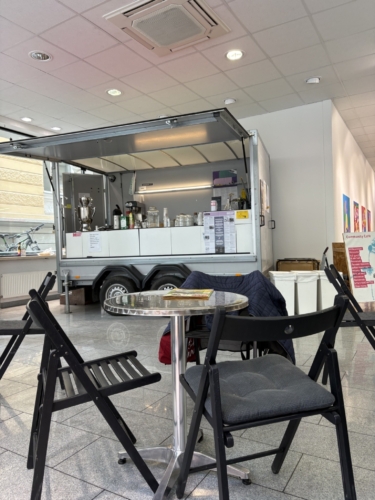
Interior of M26. Photo: Marina Schepetow
Inspired by the observation of the diversity in this street, I chose two research papers that focused on this topic in order to elaborate my research question, namely by Ash Amin (2002) on negotiation of diversity in the city and Anna Steigemann (2020) on ethnic, commercial and social diversities in two streets in Berlin-Neukölln. The papers take a closer look at diversities in cities, focusing on different aspects of this phenomenon.
Amin’s piece examines possibilities of intercultural understanding and dialogue, concluding that the main part of the negotiation of race and ethnicity happens during everyday encounters. Instead of policies that focus on mixed-housing, so-called “prosaic sites of cultural exchange” and “agonistic politics of ethnicity” are more helpful to create an authentic intercultural dialogue and negotiation (Amin 2002).
Steigemann’s study takes a look at two highly contested streets in Berlin-Neukölln, namely Karl-Marx-Straße and Sonnenallee that are important places of community practice and especially crucial for newcomers who receive support from local shop owners during their asylum process with paperwork. At the same time, urban renewal actors in that part of Berlin did not appreciate the existing diversities and community practice in the same way as newcomers and shop owners, prefer instead to change the commercial variety with a stronger focus on luxury restaurants (Steigemann 2020).
Evidence from literature as well as some first observations in the Maximilianstrasse led to the following research question: How does M26 contribute to a sense of belonging among refugees and newcomers?
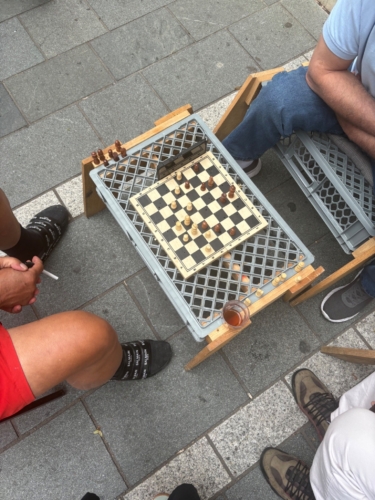
Playing chess and drinking tea on Maximilianstrasse by M26. Photo: Marina Schepetow
The results of the empirical study are based on seven qualitative interviews and multiple observations that amount to seven and a half hours. Observations were partly made in front of the entrance of M26, but mainly inside and during the hours of the Community Café in order to observe spontaneous everyday encounters of participants, specifically people with migration background. In order not to racialize people and make assumptions regarding the ethnicity and time already spent in Germany, I noted down behavior of all people in the café. Six qualitative interviews were conducted with visitors of the Community Café, as well as the Sprachcafé that is hosted by CampusAsyl, where refugees can practice the German language together and with the support of a German-speaking volunteer. Another interview was conducted with Julia Falge, a social worker that hosts the Community Café and is part of the M26 staff.
After having carried out multiple observations on different days and at different times and having conducted the qualitative interviews, I structure the collected experiences of what M26 enables into the following categories: networking, an exchange of perspectives, spatial appropriation, and offers a place of (mutual) trust, responsibility and acceptance.
For the newcomers that I interviewed, M26 is a place of networking and better understanding of Germany which encourages them to find employment and become part of German society “because the others made it, too”.
According to some interviewees’ experiences, conversations with other people in the Community Café can happen very spontaneously, but nevertheless be very deep and enable a cultural and language exchange, which is different from encounters and conversations with people in other public spaces. Not only my personal observation of a political conversation of probably Kurdish and Turkish men on the political developments in Turkey regarding the Kurdish Party PKK, but also one of my interviewees’ effort to deconstruct stereotypes around Black People can be described as an illustration of subaltern counterpublics (Fraser 1990). For the newcomers that I interviewed, M26 is a place of networking and better understanding of Germany which encourages them to find employment and become part of German society “because the others made it, too”. Furthermore, the M26 staff “accompanies” some visitors in their daily life in a certain way by being always up-to-date on what is happening in the visitors’ lives.
Another remarkable observation was the trust in other visitors by leaving one’s stuff on a chair unattended, which at the same time can be seen as spatial appropriation. Further, speaking the native language, borrowing things from M26, and sharing personal or intimate experiences, are additional indicators for mutual trust, which is again confirmed by the interviewees’ experiences and the fact that the Community Café is not always supervised by the M26 staff. This even leads to more responsibility and mutual support among visitors.
Contrary to the media coverage on Maximilianstrasse and prevalent depictions that associate it as a place of transit, crime and danger, the space inside and in front of M26 appears to be a place of regular and long stays for visitors
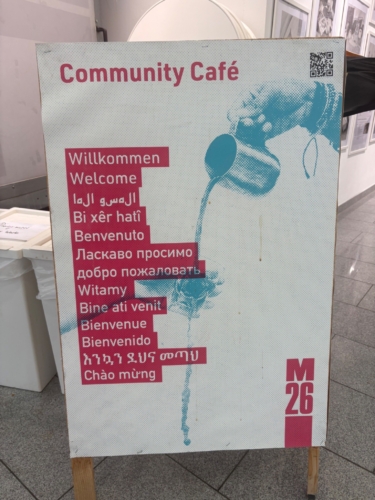
Community Café poster at M26. Photo: Marina Schepetow
Findings
Contrary to the media coverage on Maximilianstrasse and prevalent depictions that associate it as a place of transit, crime and danger, the space inside and in front of M26 appears to be a place of regular and long stays for visitors. Finally, M26 is a space where refugees as well as other visitors feel accepted and give an individual shape to the space by spatial appropriation, be it by a rearrangement of chairs or speaking in the native language in a bigger group and therefore showing a dominant presence in the room. The changing art exhibitions which constitute a crucial part of M26, somehow exist in a parallel way to the Community Café and are mainly curated by non-migrant artists and exhibitors. Julia Falge however confirmed that M26 aims at including more migrant perspectives and art in the future exhibitions

© 2026. This text is openly licensed via CC-BY. Separate copyright details are provided with each image. The images are not subject to a CC licence.
Recommended citation
Marina Schepetow. Maximilianstrasse Revisited: The relevance of “M26” for the sense of belonging of refugees. In: Frictions (20.04.2026), doi: 10.15457/frictions/0048
Copyright
© Text – Marina Schepetow. The work may be cited according to academic standards. This work may be copied and redistributed according to the terms of the Creative Commons licence.
© Images – Marina Schepetow
About the author:

Marina Schepetow
Marina Schepetow is a student of East-West Studies at the University of Regensburg. She has conducted fieldwork together with Prof. Dr. Anna Steigemann of DIMAS at UR. Marina is also a journalist, receiving a stipend from the Institut für publizistische Ausbildung (ifp). She is also a trainee with BR - Bayerischer Rundfunk. Her reports have appeared on BR, the Süddeutsche Zeitung, Mittelbayerische Zeitung and other outlets.